12-5-13
English 2010
Before starting this class I knew genre had to do with music, books, and movies, but I didn’t really think a whole lot about it. For movies you have horror and comedy, and for music you have rap, soul, hip hop, country, rock and roll, etc… As you can tell I’m more familiar with music genre than anything else, but I pay more attention to music than books or movies, unless the movie is Thor, I could watch that all day every day and not get tired of it, but that’s irrelevant.
All of my essays this semester had to do with the deaf community or deaf individuals, and when I was researching Helen Keller for my profile subject I realized that pretty much everything you can read, watch, or even listen to have a genre assigned to them; some things are harder to give a definite genre than others though. That seems obvious, but who really thinks about genre in everything that they do, of course if you’re someone who does that then maybe you’re just more observant and like to know everything you can about everything you encounter. I’m just the kind of person who watches a movie for the fun of it, and listens to music for the beat and lyrics, I don’t pay much attention to the genre. That being said, this class has at least opened my mind a little more to genre and I’m sure I will notice genre more in the things I read and watch.
When I was younger I was really into mystery, so all the books I read were under that genre, and as I got older I got more into the suspense and horror genres, but I never thought of that until this class. When you go to the library how do you decide what book you’re going to check out, do you just go for the book with the most interesting title or the coolest looking cover, no, everyone knows you look for genre first, then author (if you have a certain author you like most) and then you find the book that sparks your interest the most. Let’s say you are more of a classical music lover and you decide you want to spend your money on a new cd, so you go to the store and you find an album by someone with a really cool name, so you buy it just to find out that you don’t like it at all because its hard rock and you just can’t stand hard rock. Genre gives you an idea of what you’re getting, but if you don’t know the genre then you are just going off of your own assumptions of what you are looking at or listening to.
The final for this class was a group project. My group decided to go for an “easier” assignment, so we chose travel brochures. Sounds simple enough right? All you have to do is find a place you want to make a brochure for and some interesting things about it that would make people want to go there, and throw them on some paper, maybe add some pictures and fold the paper up and there you have it, piece of cake. That’s what I thought too, but if you’re going to make a brochure that is actually decent then you have to give it more thought then that. With brochures you don’t want to write a novel, just enough that the reader gets the general idea and becomes interested in looking into it more themselves. The main thing I’ve noticed in every genre and every assignment we did this semester was that whatever you did, you had to make sure it was interesting and could keep your audience’s attention.
Genre is all around us and when you take time to think about it, most of the things that interest you will have the same type of genre. I’m big into horror and mystery and even the games I play have a lot to do with those two genres specifically. What genres are you most interested in? If you don’t know right off the top of your head, then just look into your hobbies or favorite things and you’re bound to find the genres you like most, even though you didn’t know it.Mayan Travel Brochure Assignment
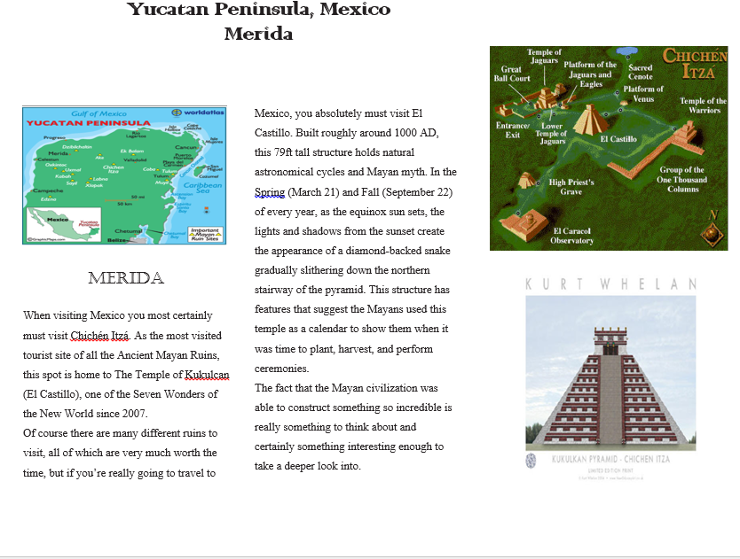
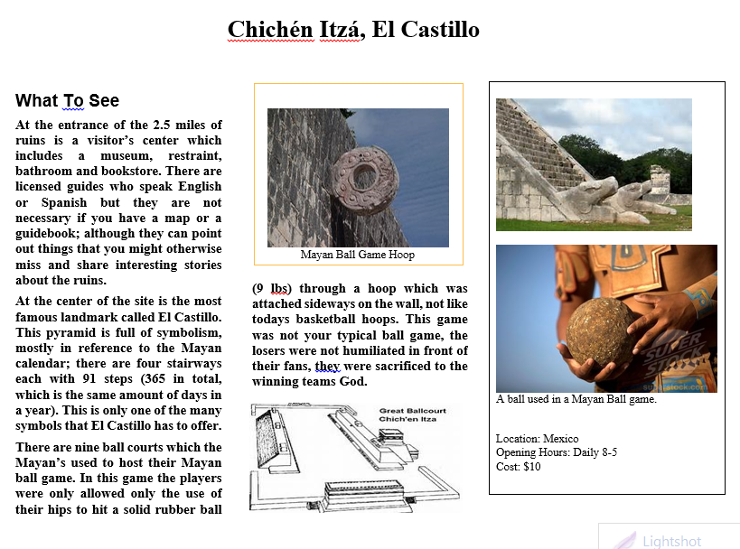
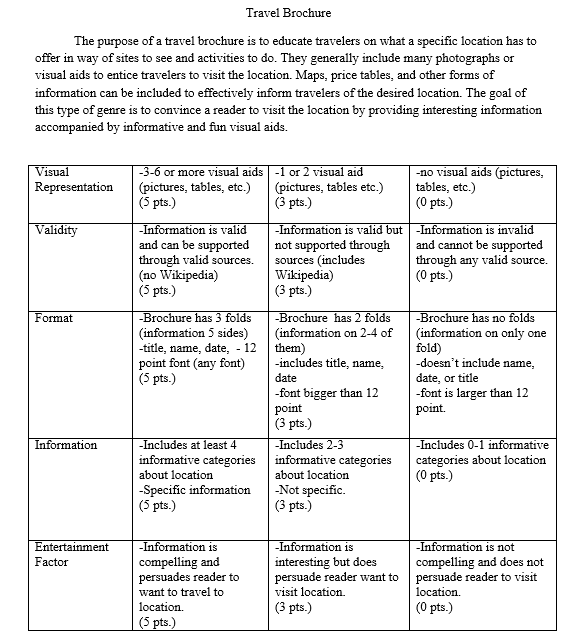
Unlike many travel brochures, mine does not have much color, the background is just plain white, but the information is still all there. A lot of brochures focus mainly on pictures and have few words to them, but everything I found was just so interesting I couldn't leave anything out.
Profile on Helen Keller
10-20-13
English 2010
Deafness vs. Determination: Helen Keller
They stick out the side of your head on both sides and sometimes you use them to keep your hair from falling in your face. Most people don’t like the way they look and try to cover them up with their hair, and others hardly ever notice or think of them. Do you know what I’m talking about yet? That’s right, ears. Have you ever thought about your ears? Those two things sticking out of the side of your head which allow you to hear the rustling of leaves being blown in the wind, rain slapping the concrete during a summer thunder storm, a conversation being held from across the room, and so many other sounds. Have you ever thought about what it would be like if you couldn’t hear? If you had ears but they didn’t work? Would you have the determination to continue to live your life, or would you feel hopeless and overwhelmed because of your deafness and just give up? Helen Keller was not only deaf, she was blind as well, but she accomplished many things in her lifetime and earned many awards for things she did. She didn’t let the fact that she was deaf and blind stop her from living, she just lived. “Self-pity is our worst enemy and if we yield to it, we can never do anything good in the world.” ~ Helen Keller
At only eighteen months old Helen Keller fell ill to a sickness doctors called “brain fever” (now said to most likely have been Scarlet Fever or Meningitis). This illness caused her to become deaf, dumb, and blind. When she was seven, a woman named Anne Sullivan came to live with her and her family, and began teaching Helen how to finger spell words. Helen was extremely defiant at times and threw rampaging tantrums; smashing and throwing things to the point where many family members felt she should be institutionalized because of her unruly and wild behavior (one of those family members being her own father). What they didn’t realize was she wasn’t trying to be unruly and wild, she was just frustrated because she had no way of communicating. She was trapped inside herself, unable to communicate or see, feeling around as she walked to avoid running into things, something which happened a lot when she got upset.
Mr. and Mrs. Keller were not very helpful when it came to disciplining Helen for her bad behavior. Until Anne arrived, Helen probably didn’t even know the meaning of “bad”, she just did as she pleased and everyone was expected to leave her alone and give her what she wanted. When Helen did something bad or started acting up and screaming, her mother would give her a piece of candy to get her to stop. There was one day Anne finger spelled the word “pen” into Helens palm and then gave her a pen so she could feel what a pen was, after Helen ran her fingers over the pen a few times she suddenly stabbed Anne’s hand, and when Anne tried to take the pen from her she began screaming and thrashing, but stopped when Mrs. Keller gave her a piece of candy. When Anne saw this she asked, “Why is she being rewarded for stabbing me?”, but Mrs. Keller gave her a bewildered look and replied, “I don’t know.” Helen was allowed to do as she pleased because she was deaf and blind and everyone was expected to feel sorry for her, not only this but they didn’t know how to control her, so instead of treating her like any other child, they just ignored her bad behavior and gave her whatever she wanted to avoid the tantrums.
Anne realized if she was going to accomplish anything she had to do something drastic, so it was decided she and Helen would move into the small farm cottage away from everyone else for a while, this way Anne could teach her without the interference from her family. Anne was only given two weeks to teach Helen as much as she could because Mrs. Keller couldn’t stand being separated from her daughter. After their two weeks were up Anne reluctantly returned Helen to her family, wishing she had been given more time to teach her. Anne could see potential in Helen that the others couldn’t, not only because they didn’t take the time to see it, but because they didn’t think Helen was capable of learning. That night at dinner instead of sitting still and eating politely with a knife and fork, the way Anne had taught her, Helen began acting as she always had before; she threw her napkin and utensils on the floor and began eating with her hands, walking around the table taking food from others’ plates. Anne knew she had taught Helen better and tried to get her to sit down and eat properly, but after a few minutes of fighting with her, Helen threw a pitcher of water on Anne, so, Anne removed her from the table and carried her outside to fill the pitcher up again, which Helen’s parents didn’t agree with, but reluctantly permitted after Anne lectured them on the importance of disciplining her. She took her to the water pump and handed her the pitcher, but when it was almost full Helen dropped it and put her hands under the water, curious as to how it was coming out of the pump. Anne, realizing Helen wanted her help now, finger spelled the word “water” into her palm, Helen then dropped down and patted the ground holding her hand up to Anne for her to finger spelled the word “ground” into her palm. It was then that Helen realized the letters Anne had been finger spelling to her this whole time had meaning and belonged to something/someone. After this experience Helen wanted to learn; everything she touched she wanted to know about and became enthusiastic about learning.
Because Helen wasn’t “normal”, her family and everyone else around her didn’t know how to handle her or how to teach her, so they didn’t even try. They made the same mistake many people are still making today; they confused having a disability to mean being incompetent or stupid, incapable of learning. Helen was deaf and blind, her mind was not damaged in any way, and she could think for herself and make her own decisions when given the chance. Just like any child, she needed to be taught discipline, and once she understood right from wrong she was able to progress. Although being deaf and blind was certainly an obstacle for Helen, those things never stopped her from progressing in life and becoming such an inspirational and incredible person in history. Having a disability does not mean you are stupid, and it certainly doesn’t mean you can’t be someone important, Helen Keller is a perfect example of this. “While they were saying among themselves it cannot be done, it was done.” ~ Helen Keller
Most people, when they think of Helen Keller, think of the ill-mannered, angry child the world has labeled her as, and the cruel jokes about her and her disabilities. If people actually took the time to research Helen Keller, they would find that she wasn’t really a bad kid, she thought the same way any other child thought, but she couldn’t communicate in the same way every “normal” child communicated. She knew what she wanted and she knew how to get it, but unlike an “undamaged” child, she wasn’t disciplined, so how could she have known the things she was doing were bad, when no one had ever told her. You can’t expect a child to know something they haven’t been taught, just like you wouldn’t be able to do something in your job that you weren’t trained to do or know about. Another thing people would find from research is that although Helen Keller was deaf and blind, she was not at all stupid, quite the opposite actually. Once Helen finally realized that all the letters Anne had been signing to her were connected with the things around her, her learning process took off like wild fire; she wasn’t stupid, she just needed a good teacher to help her find her way through the dark, sightless world she had to live in. “Many people know so little about what is beyond their short range of experience. They look within themselves- and find nothing! Therefore they conclude that there is nothing outside themselves either.” ~ Helen Keller
Helen Keller is one of the most well-known deaf people in history because of the many beneficial things she did for the blind community. Three of these things being that (1) she co-founded the Helen Keller International with George Kessler in 1915; an organization focused on preventing blindness and reducing malnutrition worldwide. The people benefitting most from this organization are those of the lower class, the ones at a disadvantage and need the help, because they can hardly help themselves. (2) She also helped found the American Civil Liberties Union (ACLU) in 1920, though you have to dig pretty deep to find her name in anything related to it because her contributions have been swept under the rug, in a manner of speaking, due to some things she said/wrote about communism and socialism. There is not a whole lot of proof or information about her involvement in the ACLU, but she was part of it. (3) President Lynden B. Johnson awarded her with the Presidential Medal of Freedom in 1964 for her hard work in helping people with disabilities around the world. The Presidential Medal of Freedom is the highest award a civilian can get in the United States. This award is only given to those who have made a huge contribution to the betterment of the United States. Helen Keller was awarded this medal because of the many things she did for disabled people around the world, not just the United States. This alone should be enough to prove that Helen Keller was an amazing person and true inspiration.
Helen Keller may not be the only person in history to have worked so hard to help the less fortunate, and those with disabilities, but she herself was deaf and blind. She was disabled and yet she spent her life trying to help others who were disabled, others who couldn’t or didn’t know how to help themselves. She actually understood how those people felt because she had lived her whole life as a disabled person, and had many of the same obstacles all the other disabled people had to face in their daily lives. When she was a child, her own family treated her like an invalid and a burden because she was disabled, yet that never stopped her from becoming someone of great importance. She was always giving inspirational speeches, trying to help disabled people realize their importance, and that they could become anything they wanted to become if they had enough determination to achieve their goals. She could have given up at any point in her life, but she didn’t, and she is a perfect example to everyone with a disability that you shouldn’t let your disability stop you. “The marvelous richness of human experience would lose something of rewarding joy if there were no limitations to overcome.” ~ Helen Keller
There is a difference between living with a disability and living through that disability. The first being that you have a disability, and the second being that you dwell on the fact that you have a disability and let it control your life; or expect to be catered to because others have you convinced you can’t do things for yourself. Helen Keller was always inspiring people not to let their disabilities stop them from living their lives to the fullest, and that is why she was, and still is, an inspiration to millions of people around the world.
